Most clay retreats in Portugal begin with a bag of clay already on the table. Ours begins with a walk across a field and a small shovel. Before anyone touches the studio, we go out to the land and dig the clay ourselves.
I teach the human figure in clay, and I have done it for eleven years, with more than 6,000 people in Berlin, Vienna, Barcelona and Lisbon. On the farm, I want you to see where clay comes from before you shape it.
What most clay retreats in Portugal offer
If you search for a clay retreat in Portugal, you will mostly find pottery. The wheel, glazes, a kiln, and at the end a set of cups or bowls. These are good retreats, and Portugal has a long, rich tradition of ceramics to support them.
A few go further. Some work with wood firing, some with local clay, some combine pottery with yoga or walking.
What you rarely find is a retreat where you meet clay as earth first, and then use it to make the human body. That is what our Weekend Retreat is built around. You will not find a wheel or a glaze bucket here, only the ground, a live model, and the fire.
Walking out to the earth
On the first afternoon, after you have settled into your room and we have met around the opening fire circle, we walk out together. Behind the Zen garden at Quinta Carvalhas, past the horses, there is a place where the earth holds clay.
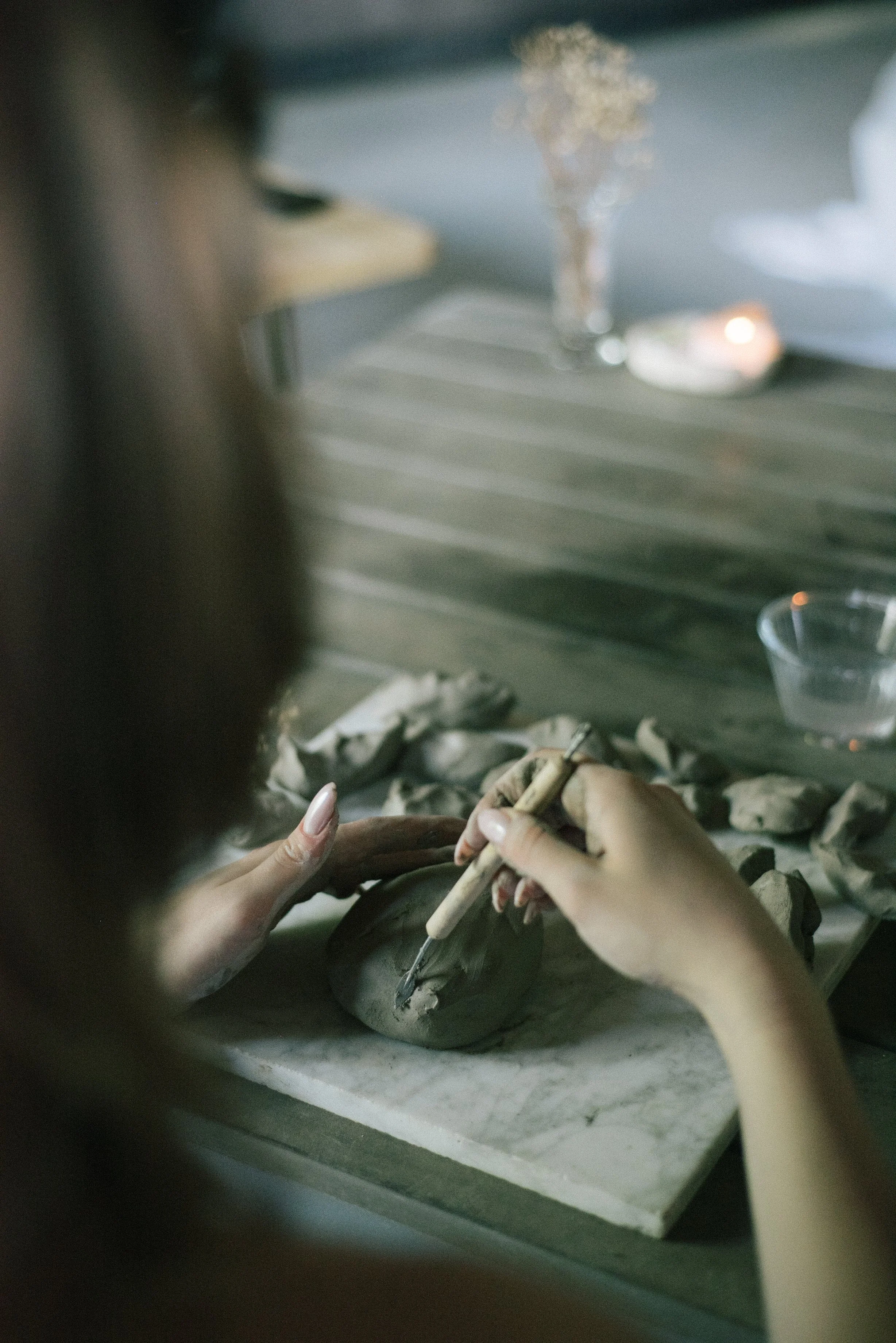
I show you how to recognise it. Clay feels different from ordinary soil when it is damp: smoother, heavier, a little sticky between the fingers. Then I show you how to separate it from the ground, from the stones and roots and loose earth that live with it. Each of you fills a small cloth bag with your own clay powder to take home.
It is quiet work. You crouch, dig, rub the earth between your fingers, and the conversation slows down by itself.
Why we start with the ground
We tend to think of clay as something bought in a bag. In fact it lies under much of the world: in riverbanks, in fields, in the subsoil below the grass. Learn to recognise it once, and every landscape you visit becomes a possible studio.
That is a quiet kind of freedom, and it is the first reason we dig.
The second reason is grounding, in the simplest sense. Guests come from many countries, often straight from an airport and a busy week. Kneeling on the ground and pulling clay out of it slows the body down faster than any instruction I could give. By the time we walk back, you are already somewhere else.
The third reason is the place itself. When you dig the clay of the land you are working on, the weekend becomes something like a site specific work of art. You are not making in a neutral room. You are making from this farm, in this season, with this earth.
From earth to figure
As the light goes, we go into the studio. Its walls are clay bricks, made from the earth of this same land, so the material you have just dug surrounds you while you work.
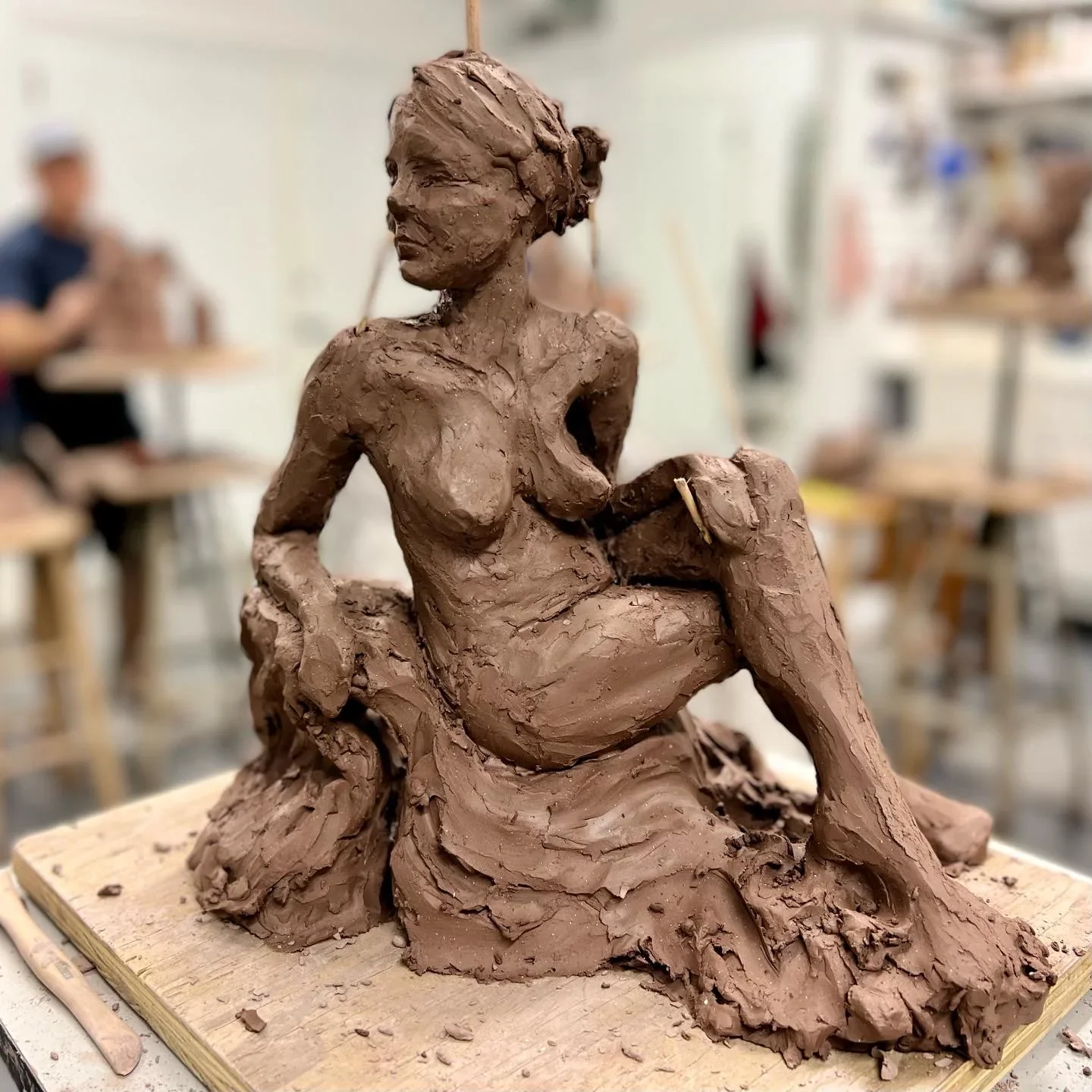
Each guest finds a table, theirs for the whole weekend, around the model. The armatures are ready. The model takes a lying pose, and the large figure begins.
For the sculpture itself we work in Portuguese clay, prepared and ready to model. The clay you dig goes home with you as powder, a small bag of this particular ground, so you can wet it, knead it and work with it later. The digging is about knowing where clay lives. The studio is about learning to see.
On Saturday the model holds the lying pose again, and after a sharing circle in the afternoon, takes a seated pose for a new piece of clay: a small figurine, the oldest kind of sculpture people ever made. You can follow the model closely, or follow yourself.
Clay from the earth, returned to the fire
Sunday morning belongs to you. Some people keep refining their figure until the last minute; others hollow their figurine, so it can travel home and be fired later at a ceramic studio near them.
Then we go outside to the fire pit for the closing ceremony. Each of you decides what to give back. If you wish, you lay your sculpture around the wood before the fire is lit. The anonymous papers from Friday, each one a story about creativity that someone is ready to let go of, are passed around the circle and placed in the pit. Then the fire is lit and everyone steps back.
This is a ritual, not a kiln. The pieces you take home are the ones you keep back from it: raw clay, hollowed, ready to dry slowly and be fired when you choose. What goes into the fire is what you are ready to release.
So the weekend makes a full circle. You take clay from the ground on Friday, give it a human form on Saturday, and return part of it to the fire on Sunday.
Many guests will be holding clay for the first time, and the weekend is designed around them. Practising artists come too, for the live model, the guidance, and the chance to work with earth they dug themselves.
You do not need any skill to dig. You need clothes you do not mind getting muddy, good shoes for the land, and a little curiosity.
Practical details
Where: Quinta Carvalhas, a farm in the Ribatejo, one hour from Lisbon. The train from Lisbon Oriente runs to Mato de Miranda, where we meet you at the station.
Dates in 2027: 12 to 14 March, and Easter, 26 to 28 March. Friday to Sunday, two nights.
Group: twelve people at most.
Price: €1,650 with a room to yourself, €1,450 each when two people share a room. The live model, Portuguese clay, tools, armatures, all meals from the farm's kitchen, the welcome kit and the station pickup are included.
What to bring: clothes for clay, warm layers, good shoes for the land.
If you want to see the whole weekend hour by hour, I wrote about it here: A Sculpture Retreat in Portugal, One Hour from Lisbon.
You can see the full program and book your place here: the Weekend Retreat.