Easter 2027 falls early, on Sunday 28 March, and I have chosen to spend it on a farm with twelve people, a live model and a great deal of clay. Our Easter retreat in Portugal runs from Friday 26 to Sunday 28 March, at Quinta Carvalhas, one hour from Lisbon.
I want to explain why Easter, of all weekends, felt right for this.
Why an Easter retreat in Portugal
For many people across Europe, Easter is one of the few long weekends of the spring. Good Friday is a public holiday in Portugal and in many other countries, and in much of Europe Easter Monday is free too. That makes it possible to travel on Thursday or Friday, spend three days away, and still have a day to arrive home and rest.
But the timing is not the only reason. Easter is, underneath its many traditions, a festival about the turn of the year: the end of a long winter, the return of light, something buried that comes back. Whatever it means to you personally, the season carries that feeling. The land outside Lisbon shows it plainly at the end of March. The fields are green from the winter rain, the days are already longer than the nights, and the evenings are mild enough to sit outside by the fire.
A weekend built around earth and fire fits that moment very naturally.
Earth, body, fire: the shape of the weekend
The Weekend Retreat has three movements, and at Easter they take on an extra layer.
The earth. On Friday afternoon, after the opening fire circle and ceremonial cacao, we walk out across the land and dig clay. I show you how to recognise it in the ground, how to separate it from stones and roots, and how to take a small bag of it home. Most people have never thought about where clay comes from. It comes from the earth, almost everywhere, and once you know how to find it you can make something wherever you live.
The body. On Friday evening and through Saturday you work in the studio from a live model, draped in textile. First a large lying figure, built slowly from life. Then, on Saturday afternoon, a new pose and a new piece of clay: a small seated figurine. Small figures of the human body are among the oldest sculptures people ever made, tens of thousands of years before any of our calendars existed.
The fire. On Easter Sunday, after a free last morning in the studio, we go outside to the fire pit for the closing ceremony.
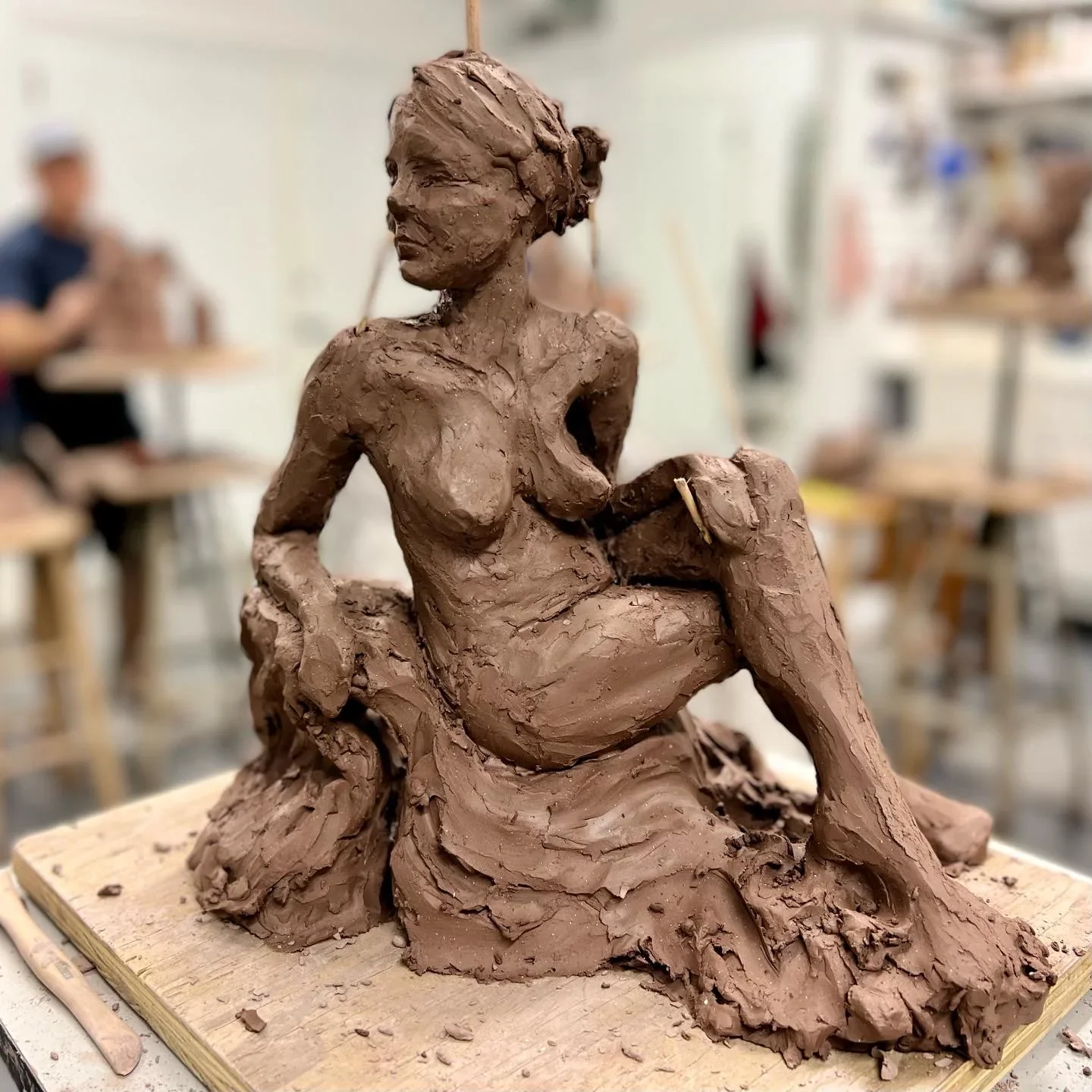
Easter Sunday, by the fire
The closing fire is the part of the weekend I think about most when I imagine it falling on Easter Sunday.
On Friday each person writes one sentence on a page from their sketchbook, anonymously: a story they tell themselves about their creativity that no longer serves them. On Sunday those papers come back. They are passed around the circle in silence until everyone has read every one. Read side by side, the fears turn out to be very close to one another, whoever wrote them.
Then each person places one paper by the wood, and each of you may lay your sculpture beside it, if you wish. The fire is lit. It is a ritual of letting go, not a kiln: the clay is raw, and what matters is the gesture. The figurine can go home with you, hollowed on Sunday morning so that it can be fired later at any ceramic studio.
Clay from the earth, returned to the fire. On the day that so many traditions give to renewal, I find that a quiet and fitting way to end.
Easter in Portugal, around the retreat
If you arrive in Lisbon a day early, you will see Easter in the city. Bakeries fill with folar, the traditional Easter bread, which can be sweet or savoury and is sometimes baked with a whole egg inside. Sugared almonds, amêndoas, are sold everywhere and given as small gifts. In the north of the country the tradition of the compasso, a small procession that visits homes on Easter Sunday, is still alive in many towns. Lisbon itself is calmer than in summer, though busier than an ordinary March weekend, so it is worth booking your night in the city early.
One small detail: in 2027 the clocks in Portugal move forward one hour in the early morning of Easter Sunday, as they do across the European Union at the end of March. You lose an hour of sleep, and gain a long, light evening for the journey home.
The weekend itself is not religious, and you do not need to celebrate Easter to come. Guests come from many countries and many backgrounds. What we share is the work, the long table, and the fire.
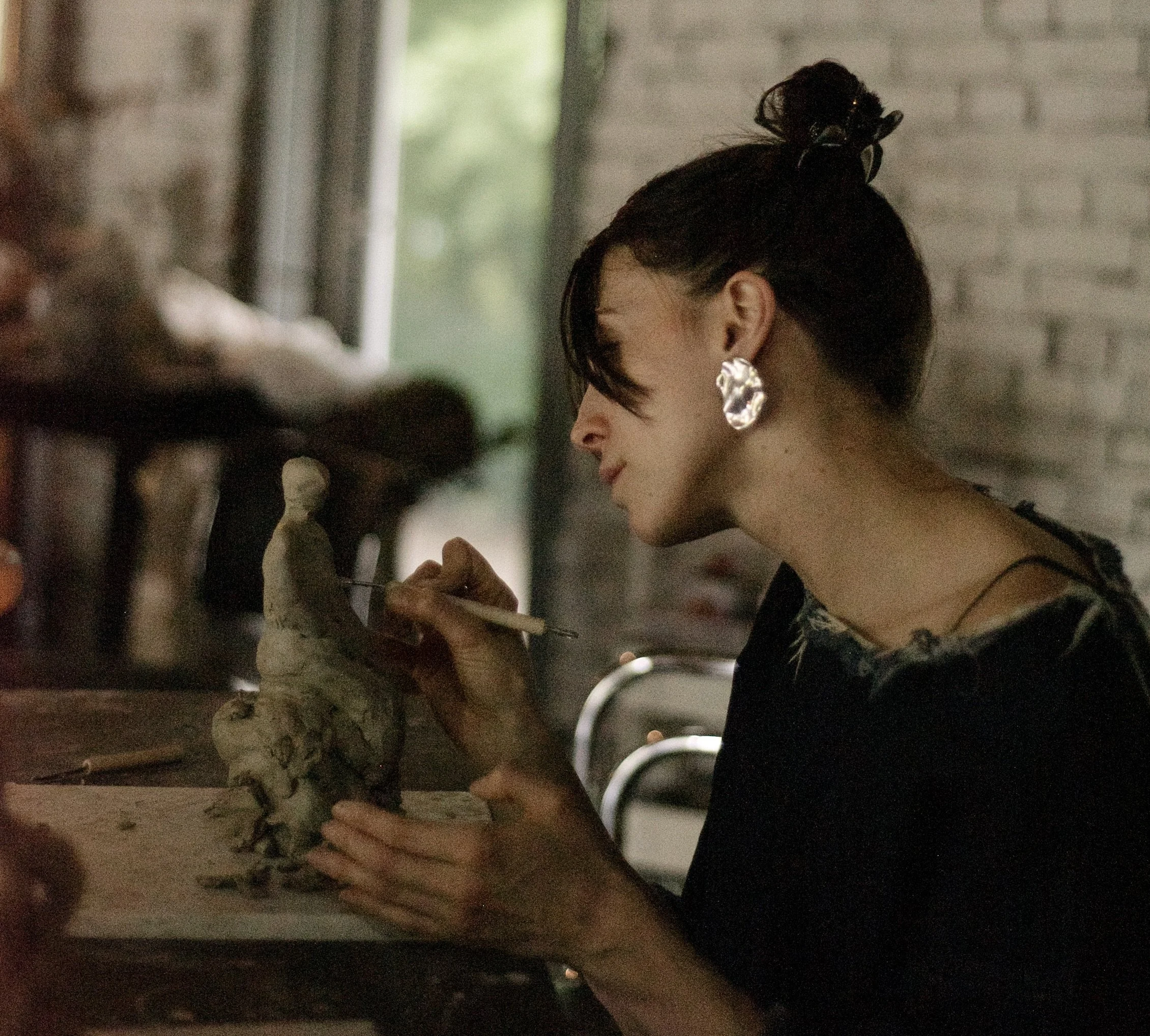
Who the Easter weekend is for
It is for people who have never touched clay, and for people who have made art for years and want studio time and guidance. Most people arrive having never touched clay, and the weekend is built for that. Twelve people at most, so I can work with each of you at your sculpture.
It is also a good Easter for two. A partner, a friend, a sister: you can share a room and come together. Families sometimes spend Easter at the same table every year. This is a way to spend it at a different table, making something with your hands.
Practical details
Dates: Friday 26 to Sunday 28 March 2027, Easter weekend.
Where: Quinta Carvalhas, a farm in the Ribatejo, one hour from Lisbon. One train from Lisbon Oriente to Mato de Miranda, and we pick you up at the station.
Group: twelve people at most.
Price: €1,650 with a room to yourself, €1,450 each when two share a room. Your room has its own bathroom and a wood fire.
Included: two nights, all vegetarian meals from the farm's kitchen, the live model, Portuguese clay, tools and armatures, a welcome kit with a wooden tool I carve by hand, morning movement, the fire circles and the station pickup.
Experience: none needed.
You can see the full program and book your place for Easter here: the Weekend Retreat.
If you want to see the whole weekend hour by hour, I wrote about it here: A Sculpture Retreat in Portugal, One Hour from Lisbon.