People often tell me they would love to learn figure sculpture, but they imagine years of training before they are allowed to begin. It does take years to master. It takes one weekend to begin properly, with a live model, good clay and someone beside you who knows where to look.
I have taught the human figure in clay for eleven years, to more than 6,000 people in Berlin, Vienna, Barcelona and Lisbon. Most of them had never touched clay. This is what I have learned about what a weekend can give you, and what it cannot.
What you can honestly learn in a weekend
You will not leave as a sculptor. You will leave knowing how to start.
That sounds small. It is not. What stops most beginners is not a lack of skill but the first step: where to put the clay, how large to make the head, what to look at first. A weekend gives you a way of working you can repeat at home, alone, for the rest of your life.
By Sunday most people understand three things in their hands, not only in their heads. That a figure is built from the inside out, around a structure. That the large directions matter more than the details: the tilt of the pelvis, the line of the shoulders, where the weight falls. And that looking is most of the work.
Learn figure sculpture by looking first
The first thing I teach is not a technique. It is how to look.
When we see a person, the mind hands us a symbol: head, arms, legs. The symbol is not what is in front of you. A shoulder seen from the side is not the shoulder you imagine. The foot of a lying figure, seen from where you sit, may look larger than the head. I ask people to stop knowing and start seeing. I call it learning to listen with your eyes.
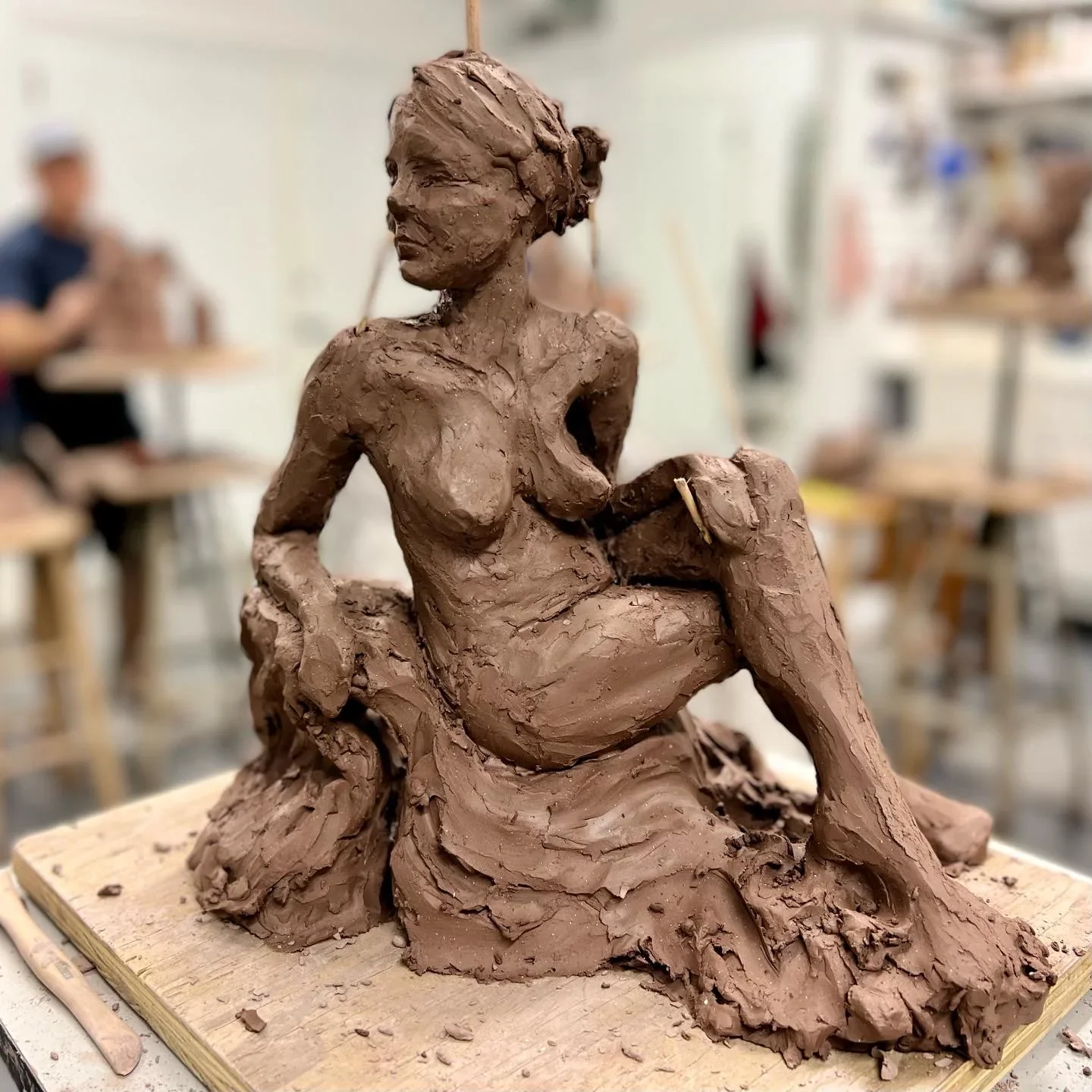
So at the beginning I keep you away from details. No eyes, no fingers, no hair. Only masses and angles. The torso is a block that turns. The head is an egg that tilts. When those are right, the figure lies or sits with conviction. When they are wrong, no amount of fine detail will save it.
The weekend, step by step
Our weekend retreat takes place at Quinta Carvalhas, a farm in the Ribatejo, one hour from Lisbon by train. Twelve people at most, each with their own table for the whole weekend.
Friday: the ground. We open around the fire with ceremonial cacao, then walk out to dig clay from the land. I show you how to recognise it and clean it, and you fill a small bag to take home. Then the studio, and the model takes the lying pose. Your first figure begins before dinner.
Saturday: the figure, and the figurine. The longest day in the studio. You return to the lying figure, build it up and refine it, while I move from table to table. After a sharing circle in the afternoon comes a new pose and a new piece of clay: a small seated figurine, small enough to hold in two hands.
Sunday: letting go. A free morning in the studio, to finish, to refine, or to hollow your figurine so any ceramic studio can fire it later. Then the closing fire.
Two figures, two scales. The large lying figure teaches structure and proportion. The small figurine teaches you to see the whole at once, quickly, and to trust your hands.
Why a live model, from the very first day
Some courses start beginners on photographs or casts. I prefer the living body. A photograph flattens everything; it has already made the decisions for you. A person in front of you has weight, breath and warmth. The light moves across the skin as the afternoon passes. You walk around the pose and it changes from every side.
That is harder, and much better. Sculpture exists in the round, so you need to see in the round. The model is draped in textile, the room is warm, the music is low. After the first quarter of an hour almost everyone forgets to feel shy and simply works.
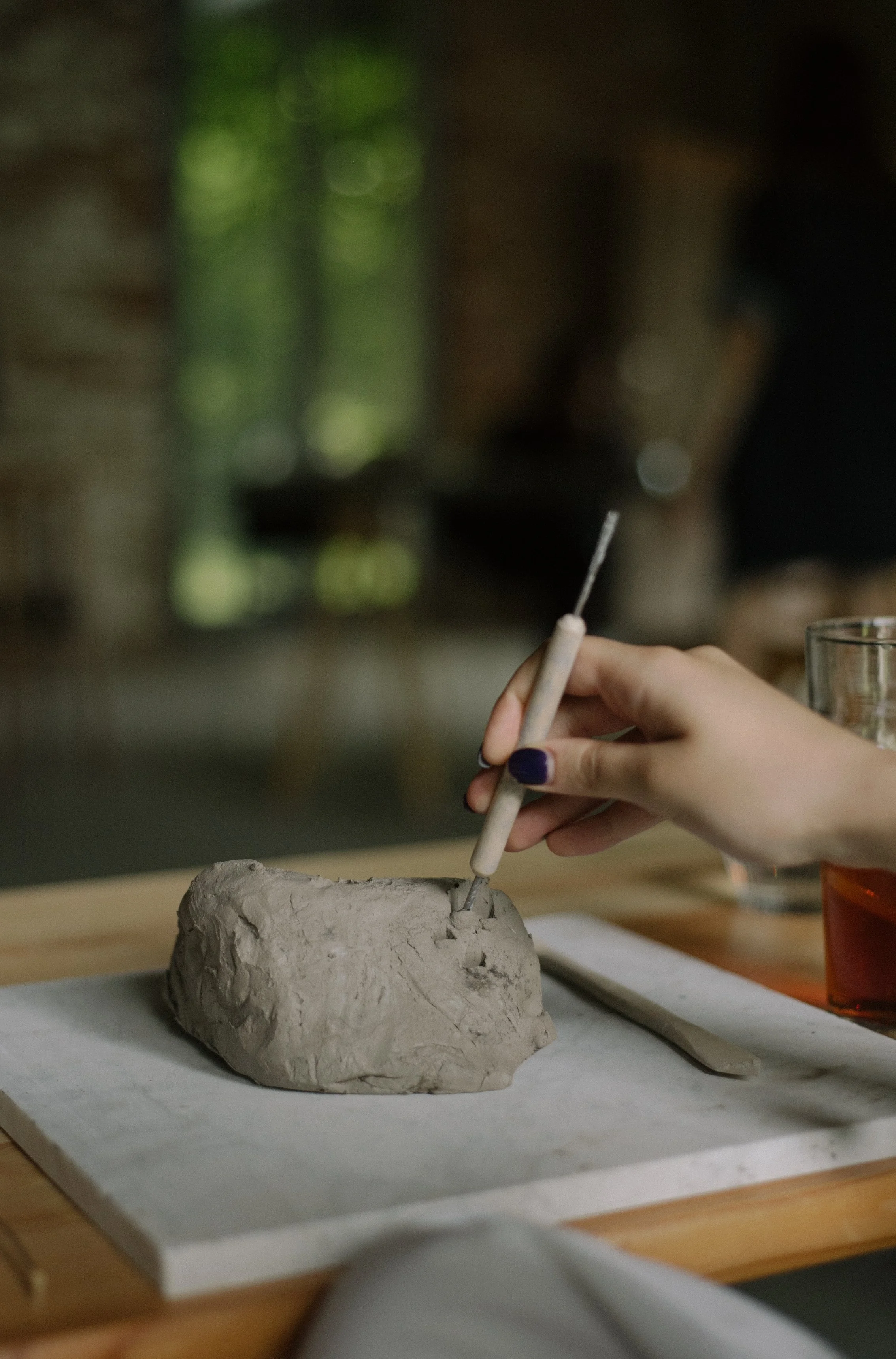
The lying figure is built on an armature, a structure that holds the clay from inside. It is ready when you arrive. We work in Portuguese clay, soft and responsive, forgiving to a first touch.
Your hands do most of the work. Tools help with the rest. Each guest receives a welcome kit: a wooden sculpting tool I carve by hand, a sketchbook and a pencil sharpened with a knife.
I come to your table often. I do not correct your sculpture for you. I tell you the one thing that matters for you right now: the angle of a hip, or that you have been looking at your clay more than at the model. Guidance is tailored to exactly where you are, whether you are a beginner or a practising artist who wants time in front of a model.
What you take home
Your figurine goes home with you as raw clay, hollowed so it can dry slowly and be fired later at any ceramic studio near you. You also take your bag of clay from the land, the carved tool and the sketchbook.
At the closing fire, sculptures can be laid beside the wood, if you wish. It is a ritual of letting go, not a firing. Each of you decides what to give back to the fire, and what to keep.
The most lasting thing is the way of working. Find clay. Build a structure. Look at the large directions first. Then look again, for longer than feels necessary.
Practical details
Where: Quinta Carvalhas, Ribatejo. By train from Lisbon Oriente to Mato de Miranda, then we drive you from the station.
Dates in 2027: two weekends, 12 to 14 March, and Easter, 26 to 28 March.
Group: twelve people at most.
Price: €1,650 with a room to yourself, €1,450 each when two people share. Two nights, all meals from the farm's kitchen, the live model, Portuguese clay, tools, armatures and the welcome kit are included.
Experience: none needed. Most people arrive having never touched clay.
If you want to learn figure sculpture with the earth and the fire around you, the full program is here: the Weekend Retreat. And if you would rather learn in the city over three days, read A Three Day Sculpture Course in Lisbon.