People sometimes write to me looking for a creative block retreat, as if the block were a wall and someone could take it down for them in a weekend. I understand the wish.
What I have learned, from eleven years of teaching the human figure in clay, is that a block is rarely about talent. It is about conditions. Change the conditions and, very often, the work starts again on its own.
What a creative block usually is
A block looks different for everyone, but the same few things come up again and again.
Too much judgement. You see what you want to make, you see what your hands make, and the gap between the two is painful. So you stop.
Too little time. Twenty minutes between emails is not enough to arrive anywhere. You start, you are interrupted, and the work never gets past its first awkward stage.
A blank page. With no subject and no limit, every choice is possible, and that is exhausting.
Working alone. Alone, it is easy to believe you are the only one who struggles.
None of these is a flaw in you. They are the normal weather of a creative life. A retreat cannot change who you are, but it can change all four conditions at once.
What a creative block retreat can actually do
Here is how a few days away work on each of them.
The time is already decided. On a retreat you do not have to defend your studio hours. They are in the program. Brunch, the studio, a break, the studio again. The decision to work was made before you arrived, so all your energy can go into the work itself.
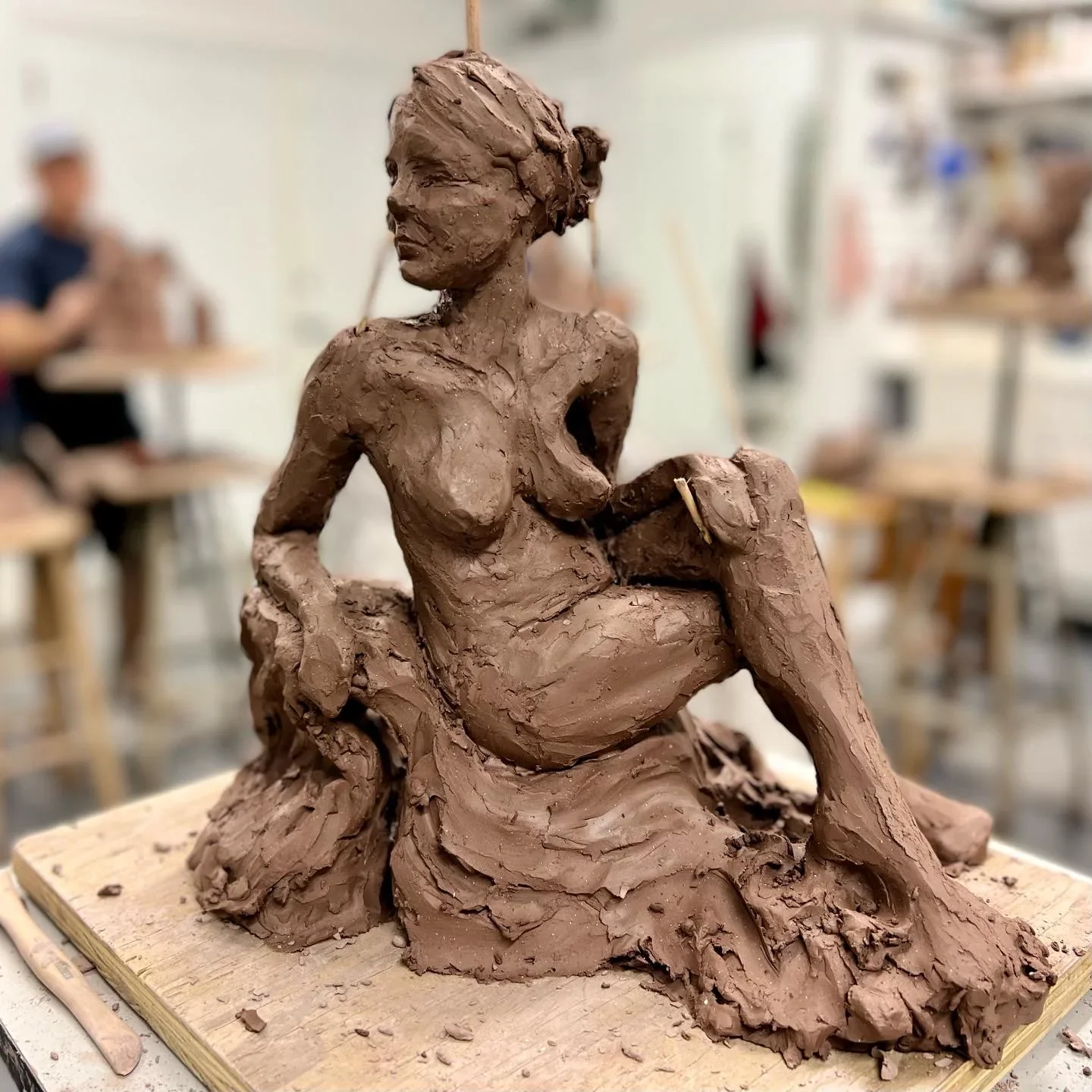
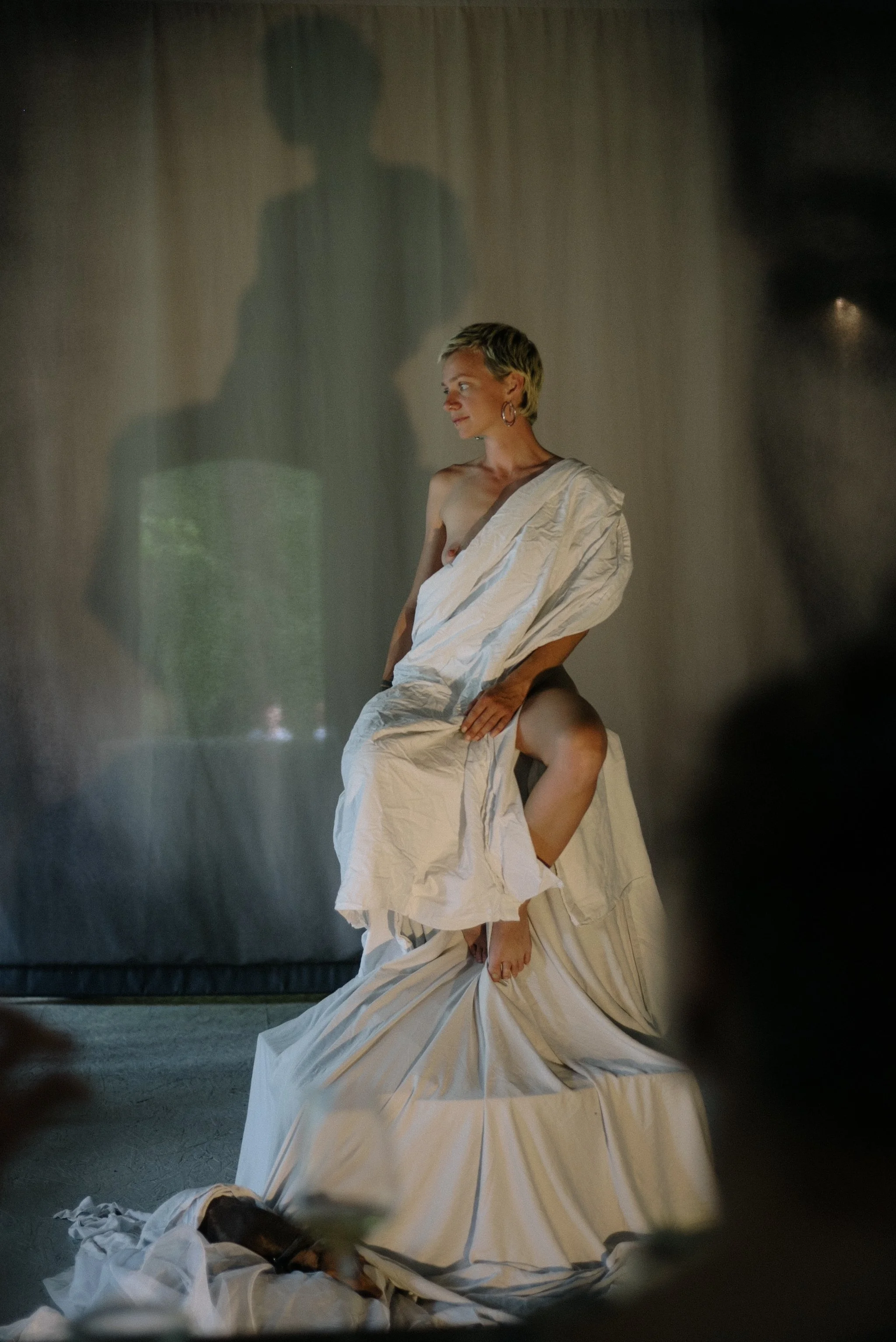
You have a subject. In my studio there is always a live model, draped in textile, at the centre of the room. You do not have to invent anything. You look, and you answer what you see. A body in front of you is the opposite of a blank page. It asks you a question every minute: how long is this arm, where does the weight fall, what happens at the turn of the neck.
The material forgives. Clay can be pushed back, cut away, built up again. Nothing is final until the very end. For people who freeze in front of a canvas, this changes a lot. You are not making marks you cannot take back. You are moving earth around until it starts to look like someone.
Other people are working beside you. Twelve people at most, each at their own table, all looking at the same model. You see that every figure is clumsy at first. You see that everyone has a moment of doubt in the afternoon. It is a relief.
Why the hands come before the ideas
When you are blocked, you often try to think your way out. You wait for the right idea, and the waiting becomes the block.
In the studio I ask you to do the opposite. Start with your hands. Build the large shapes first: the mass of the torso, the angle of the pelvis, the line from the shoulder to the floor. You do not need an idea for that. You only need to look.
I don't show you how to do it. I teach you to look at where the weight falls, how large a head is against a shoulder, how a body holds itself. The hands follow. Ideas tend to come back once the hands are busy. Not always on the first day. Often by the second.
No one is grading you
There is one more thing a retreat gives you, and it may be the most important. Permission.
Many blocks come from an imagined audience: a teacher from school, a parent, a critic, your own feed. In my studio no one is grading you. There is no right answer and no finished piece you have to defend at the end. I guide each of you at your own level, at your sculpture, and I tell you what I see. The work stays yours.
Most people who come to me have never touched clay. Some are practising artists who come precisely because clay is not their medium, so there is nothing to protect. For both, the effect is similar. For a few days, the worry has somewhere else to go.
Three ways to step away
I run three formats. They share one structure: we look before we touch.
The Sculpture Course in Lisbon. Three days in my studio in Marvila, by the river. About sixteen hours in the studio with a live model, lunch together, and your evenings free in the city. Two figures, lying and seated, both hollowed on Sunday so any ceramic studio can fire them. Both go home with you. Good if you want to keep Lisbon around you.
The Weekend Retreat. Three days at Quinta Carvalhas, a farm in the Ribatejo, one hour from Lisbon. You dig your own clay from the land, sculpt the figure from life, and close the weekend around the fire, where you can let go of the stories you tell yourself about your creativity. Good if you want a clean break from routine.
The Signature Retreat. Five days in December at the same farm. Mornings in silence, long poses, more than twenty hours in the studio. Good if the block is deep and you need real time to get underneath it
Practical details
Sculpture Course, Lisbon: 19 to 21 February and 23 to 25 April 2027. €890.
Weekend Retreat, Quinta Carvalhas: 12 to 14 March, and Easter, 26 to 28 March 2027. €1,650 with a room to yourself, €1,450 each when two share.
Signature Retreat, Quinta Carvalhas: Sunday 5 to Thursday 9 December 2027. €3,200 with a room to yourself, €2,800 each when two share.
Group size: twelve at most.
Experience: none needed.
A block is not the end of your creativity. Often it is only a sign that the conditions need to change for a while. If you want to change them with clay, a live model and a few days away, you can see every date here: see the retreats. And if silence is what you need most, read The Silent Sculpture Retreat: Five Winter Days in Portugal.